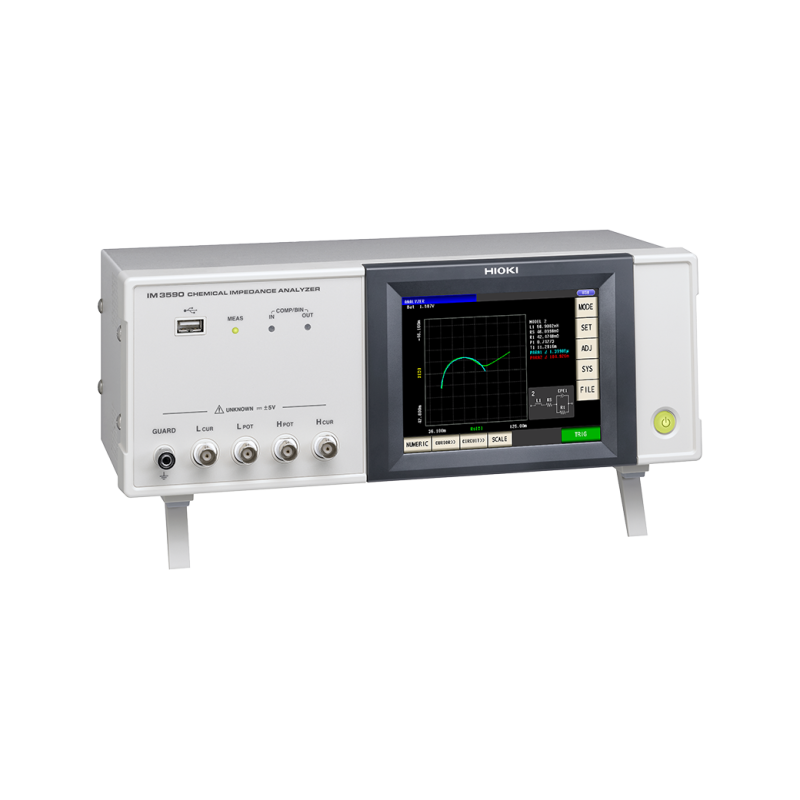
One of the biggest strengths of the HIOKI IM3590 is its focus on electrochemical measurement. HIOKI states that the instrument is especially suited to electrochemical impedance measurements and includes graphing functions needed for battery and chemical material testing. In addition to standard LCR measurement, the IM3590 can generate Cole-Cole plots and support equivalent circuit analysis, helping researchers study internal battery phenomena such as charge transfer resistivity at the electrode-electrolyte interface and mass transfer processes in electrolytes.
The wide frequency range is a major advantage for this type of work. HIOKI specifies a measurement frequency range of 1 mHz to 200 kHz, which supports analysis of ion behavior, solution resistance, and frequency-dependent characteristics of electrochemical materials. This broad coverage makes the IM3590 suitable not only for batteries and EDLCs, but also for electronic components, piezoelectric elements, and resonant elements that need detailed frequency characteristic evaluation.
The HIOKI IM3590 also combines speed with precision. HIOKI lists basic accuracy of ±0.05% rdg. for Z and ±0.03° for phase angle, along with high-speed sweep measurements in as little as 2 ms under representative conditions. This combination allows users to perform continuous measurement and high-speed testing of both standard LCR measurements and sweep measurements using a single instrument, which is valuable in both laboratory development work and structured evaluation environments.
Another notable capability is battery internal resistance measurement in the no-load state. HIOKI explains that the IM3590 can automatically measure battery voltage and generate the same DC voltage, allowing it to measure a battery’s internal resistance with no load applied. The specified battery measurement range is 10 mΩ to 10 Ω with a battery voltage of 5 V or less. For engineers studying battery performance and degradation behavior, this function adds strong practical value.
The IM3590 supports a wide range of measurement parameters, giving users flexibility for different test objectives. According to HIOKI, the instrument measures Z, Y, θ, Rs (ESR), Rp, Rdc, X, G, B, Cs, Cp, Ls, Lp, D (tanδ), Q, temperature, conductivity, and dielectric constant. Its measurement range is 100 mΩ to 100 MΩ across 10 ranges. This broad parameter set makes the IM3590 useful for both component-level analysis and deeper material characterization.
For users who need to study how characteristics change under varying conditions, the HIOKI IM3590 offers several useful functions. HIOKI lists DC bias measurement, temperature measurement, DC resistance temperature compensation, and time interval measurement with up to 801 points. It also supports frequency sweep measurement through up to 801 points, as well as sweeping through multiple signal levels and DC bias voltages. These features help researchers observe how electrochemical components and electronic materials respond to changes in operating conditions and time.
Workflow support is another area where the IM3590 stands out. HIOKI includes functions such as comparator judgment, BIN measurement, panel loading and saving, and memory functions. For connectivity, the instrument provides EXT I/O, USB communication, and USB memory, with one optional interface selectable from RS-232C, GP-IB, or LAN. This makes it easier to integrate the analyzer into laboratory systems, automate data collection, and support repeatable testing procedures.
From a hardware perspective, the HIOKI IM3590 is a compact benchtop instrument with a 5.7-inch color TFT display, 100 to 240 V AC power supply, dimensions of 330 mm × 119 mm × 168 mm, and a weight of approximately 3.1 kg. HIOKI notes that the unit is not supplied with measurement probes or test fixtures, so users can select the appropriate accessories for their specific application.
Overall, the HIOKI IM3590 Chemical Impedance Analyzer is a strong solution for engineers and researchers working with electrochemical components, battery materials, EDLCs, and advanced electronic components. With its wide frequency range, Cole-Cole plot generation, equivalent circuit analysis, no-load battery internal resistance measurement, and high-speed precision testing, it supports deeper insight into material and device behavior.
Contact us, we provide you a solution.